
 From August 1, 2019 to December 31, 2019, Minnesota law enforcement officers issued more than 9,700 tickets for violating the hands-free cellphone law.
Less than two percent (178) of the cited drivers were able to get their tickets dismissed when they took them to court, according to court records reviewed by the Minnesota Star Tribune. More than 75 percent of drivers who received citations saw their tickets and fines upheld.
Most of the other citations that do not fit into either category are either still processing or continued for dismissal, which means the charges could be dropped after a certain amount of time, provided the driver does not have any further violations.
The hands-free cellphone law specifically makes it harder for drivers to fight tickets in court.
What Does the New Law Say?
Under the new law, drivers in the state of Minnesota are only allowed to touch their cellphones one time or use voice-activated commands when attempting to make calls, send text messages via voice, get directions or listen to music while driving. Touching the phone multiple times to do any of these things is against the law.
Drivers are not allowed to hold a phone in their hand unless it is an emergency or life-threatening situation. Some other phone related activities that are prohibited under the new law are: video chatting, live-streaming video, looking at videos or photos, Snapchat, gaming, reading text messages, typing, scrolling and using non-navigation apps.
Exceptions to the Rule
Using a GPS is allowable, if the device can only be used for this purpose. In-car screens can also be used; however, these systems are usually programmed to lock when the car is in motion.
Although law enforcement agencies have been implementing a more hands-free approach to cellphone usage, any person performing official duties in an authorized emergency vehicle can legally hold a phone.
The law treats smart watches as communication devices, so they fall under the same restrictions as cellphones. A driver can look at his or her watch to check the time, however, one-touch or voice activation must be used for any other activities.
Breaking Down the Numbers on Hands-Free Law Violations
Of the 9,700 cellphone violations, there were over 2,100 drivers who were cited for playing games, watching videos or using other apps. Over 3,000 drivers were caught reading or writing an electronic message and most of the rest of the offenders were holding a cellphone while talking, video chatting or dialing a phone number.
Most offenders were between the ages of 30 and 49 with a total of 4,394 citations. Drivers between the ages of 16 and 29 comprised the second largest group with a total of 3,414 violations. Most of the rest of the citations were given to drivers between the ages of 50 and 75.
In all three age groups, men outnumbered women in the total number of violations. In the 30 to 49 age group, 54 percent of the violators were male. In the second largest group (ages 16-29), 55 percent of the offenders were male.
According to the National Highway Traffic Safety Administration (NHTSA), fatalities caused by traffic accidents have decreased by an average of 15 percent in 12 of the 15 states that have implemented hands-free statutes.
What are the Penalties?
The first offense comes with a $120 fine, and the fine jumps to $300 for each subsequent offense. This includes court fees.
Law enforcement officials must prove beyond a reasonable doubt that a driver disobeyed the law, however, it is much easier to prove because of the clarity of the law and how it explains what is allowed and what is prohibited. Police can also use dashcam video footage as evidence to prove that you were holding your cellphone while driving.
Ways to Go Hands-Free
There are several ways to avoid getting ticketed for using your cellphone, however, some are more expensive than others:
- Turn off your phone, turn-on the do not disturb feature or put it in the glove compartment.
- If you need to be on the phone while driving, you can try pairing your phone with your vehicle so you can go hands-free. If your car does not have this feature, you may need to connect your phone to an auxiliary wire to use the vehicle’s audio system to talk on the phone. Older vehicles with a cassette player can connect to your phone with an adapter that fits into the cassette player.
- You can also purchase a clip to attach your phone to the dashboard and use it in voice-activated mode. Make sure the phone is securely attached to prevent it dropping or falling onto the floor.
- Another option is to purchase a blue-tooth speaker or earphone and pair it with your phone.
Contact a Licensed Lawyer for Legal Assistance
If you or someone you know was injured in a car accident that was caused by a distracted driver, we recommend contacting a licensed attorney. Compensation may be available for medical expenses, pain and suffering, and any property damage.
The Minneapolis car accident lawyers at TSR Injury Law are prepared to hear the details of your accident in a complimentary consultation. There are no upfront or hidden fees and you are not obligated to have us represent your claim.
Our phone lines are open 24/7 to take your call. Phone: (612) TSR-TIME.
 Fatigue can affect drivers in much the same way alcohol intoxication can. Tired drivers may have slower reaction times, poor judgment and poor depth perception, all of which creates a higher risk of a crash.
 Left turns are one of the most dangerous traffic maneuvers because you are cutting across one or more lanes of traffic that are going in the opposite direction. If you pull out too soon, you risk getting into a dangerous crash with another driver who may have the right of way. You may be at fault for this type of collision.
 Attorney
  Merging with other traffic can be dangerous, particularly when you are entering a highway and other vehicles are traveling at high speed. A slow-moving vehicle colliding with a fast-moving vehicle is a recipe for severe injuries.
 Attorneys
 Many car crash victims do not know the dangers of providing too much information to an insurance company after an accident. They may think they need to talk to the insurance company to get things resolved. They may also be desperate for compensation because of mounting medical bills, wage loss or property damage.
 Our firm recently represented the victim of a crash caused by a driver who ran a red light. The impact caused the victim’s spine to be whipped back and forth, ripping a disc and causing significant pain. Unfortunately, this injury became chronic.
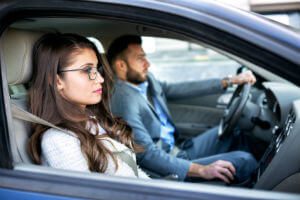 If you were injured in a car crash in Minnesota, you can pursue compensation from your own car insurance. What happens if you were a passenger in the accident?
 Some car crash victims may assume they are unable to file a claim because they were not wearing a seat belt at the time of the collision. The problem is, the issue can be a lot more complicated than that.
 Drivers have a legal obligation to properly maintain their vehicles to ensure they are safe to operate. If they fail to uphold this duty and a crash results, they may be held liable for their negligence.