What if a Car Crash Witness Refuses to Cooperate or Testify at Trial?

subpoena formStatements from a credible witness are the best way to prove the facts of how a crash happened. While many witnesses choose to help, some may be reluctant or may even refuse. Even if a witness gives a statement right after the crash, they may refuse later on if the case goes to trial.

What if you need witness testimony to validate your case? Can witnesses be compelled to testify? Can witnesses be compelled to provide a statement for an insurance claim?

TSR Injury Law’s experienced attorneys discuss these issues below. We have taken on many car crash cases, working with many witnesses and also going to trial. We are ready to help you with every aspect of your case, with the goal of recovering maximum compensation.

We do not charge upfront fees. Call today: (612) TSR-TIME.

Why Witnesses May Not Want to Get Involved

A witness does not have much to gain from helping. Although they may gain some personal satisfaction for doing the right thing and helping a victim by telling the truth, sometimes the fear of becoming involved outweighs the “trying to help” scale. The scale may be tipped more to helping if the at fault party broke the law (drinking, texting or running a light) and the witness is more motivated to help.

Witnesses have a lot of things going on and they think they may not have the time. Witnesses may fear retaliation from the bad actor, or they may think their insurance rates are going up if they have the same insurance company. A witness may have a criminal record, and he or she may be concerned it will be used against them by the insurance company.

If your lawyer is filing a liability insurance claim, the witness may know the at-fault driver. The witness may not want to help someone obtain compensation from the at-fault driver’s insurance company. The at-fault driver’s insurance premiums may increase if the claim is successful.

Witnesses may not want to deal with the stress of the legal process. They may need to talk to insurance adjusters and attorneys many times. Witnesses may fear the case going to trial, so they decide not to get involved in the first place. The thought of going to court makes many people anxious, including witnesses, who may have to testify and deal with cross examination.

Getting Witnesses to Help With an Insurance Claim

Some witnesses just need to talk to a lawyer and get their questions answered. After that, some witnesses may be more likely to decide to help you with your claim. For example, your lawyer can explain that by giving a clear statement up front, there is less litigation later. Clear statements promote settlement. This means a trial is unnecessary. An attorney telling this to a witness may be enough to convince him her to take part in your claim.

Your Bloomington vehicle accident lawyer may also need to explain how much of a commitment a witness will need to make. It may be a few phone conversations and a meeting with your attorney. Sometimes all it takes to convince a witness to help is a conversation with an experienced lawyer.

Can Witnesses be Compelled to Testify?

Sometimes attorneys file subpoenas to compel witnesses to testify in court or take part in a deposition. It is important to note a subpoena can only be filed after a lawsuit has been filed.

You should hire an experienced attorney to represent you because he or she will know when a subpoena may be necessary. You want to be able to trust that your case is being managed appropriately.

Filing a subpoena may be necessary if the witness’ testimony is vital to the case. In other words, your attorney may be more likely to file a subpoena If the case will be harder to prove without the witness’ testimony.

Can a Witness Refuse to Comply With a Subpoena?

For the most part, people are required to comply with subpoenas, with rare exceptions. For example, people must have a reasonable amount of time to respond to a subpoena. If a witness does not have enough time to respond, he or she may not be required to comply.

Witnesses may be able to ignore a subpoena if they can prove complying with it creates an undue burden. There is a lot of room for interpretation about an undue burden, which is why each case needs to be assessed on its own.

If a witness can avoid being served the subpoena, he or she cannot be forced to comply with it.

Contact TSR Injury Law to Discuss Your Claim

Think you do not need a lawyer to help you?

Have you considered that the insurance company will be looking for any reason to deny or devalue your claim? Insurance companies are profit-driven. Therefore, they are interested in denying more claims than they pay out.

TSR Injury Law’s attorneys represent injured victims at no upfront cost. We have been advocating for injured victims in Minnesota since 1998, recovering $1 billion in compensation.

Contact us today to learn more: (612) TSR-TIME.

Whose Insurance Pays for Damages From a Peer-to-Peer Carsharing Crash?

carsharing graphic with tableYou may have heard about peer-to-peer carsharing. You may have even made use of a peer-to-peer carsharing service. If you need to use a car for a short period, peer-to-peer carsharing can be a low-cost, convenient way to do it.

However, questions often arise when a crash occurs. Whose insurance is liable for the damages? Can you still seek compensation from your personal injury protection insurance if you were injured in a car you were borrowing? Can the victim seek compensation from the liability insurance of the person driving the shared car?

Below, we discuss liability issues that may arise after a crash involving a peer-to-peer carsharing vehicle. If you were a victim of this type of crash and have questions about seeking compensation for your damages, give us a call today. There are no upfront fees for our services.

How Does Peer-to-Peer Carsharing Work?

Carsharing is not the same as ridesharing. Services like Uber and Lyft are different from carsharing companies like Turo, Zipcar and Getaround.

Carsharing means you pay to rent a car from an individual who signs up for a carsharing program. Ridesharing is different because you are only paying to get a ride in someone else’s car, you are not paying to drive someone else’s car.

People may sign up for carsharing and allow their car to be used as a quick way to make extra money. People who make use of these services may do so because they want to avoid the expenses that come with owning or leasing a car.

How Does Insurance Coverage Work After a P2P Carsharing Crash?

If you get into a crash involving a peer-to-peer carsharing vehicle, you can seek compensation from your personal injury protection insurance. The process will be the same as it would be for a crash involving a vehicle that was not part of a peer-to-peer carsharing service. Your personal auto insurance follows you and will cover your medical bills and wage loss, under the no-fault system, for the $20,000.00 mandatory minimum under Minnesota law.

However, what if you also need to file an at-fault liability insurance claim? Can you file a claim against the insurance of the driver of the carsharing vehicle? Would you need to file a claim with the insurance of the owner of the vehicle? What about filing a claim against the P2P carsharing company?

These are questions that should be reviewed with an experienced Bloomington-area car accident attorney.

Here is a brief explanation of the coverage offered by some of the popular carsharing companies. If you were injured in a crash with the carsharing vehicle at fault, you may be able to seek compensation from this coverage:

Turo

Turo hosts (the people renting the cars out) can choose from one of five insurance plans, but all five come with $750,000 in third-party liability insurance. However, each plan pays 100 percent of eligible damage costs, after the deductible is paid.

Zipcar

Zipcar provides the minimum amount of liability insurance the state requires. However, this coverage does not kick in until all other coverage has been exhausted.

Getaround

This company provides liability coverage up to the minimum requirements in the state where the car is being shared. However, this coverage is secondary to any other available insurance coverage. Vehicle hosts have $1,000,000 in liability coverage.

What if You Get Into a Crash While Driving a Carsharing Vehicle?

Your personal injury protection insurance should apply to your economic (medical bills and wage loss) damages. You may also be able to seek compensation from the liability insurance of the driver who is at fault for the crash. If the other at-fault vehicle does not have insurance, or not enough, then your personal auto coverage or the P2P coverage may apply.  Both policies need to be reviewed to determine coverage priorities.

Obtaining full compensation on your own can be a challenge. An experienced attorney can investigate what happened and negotiate with the insurance company on your behalf.

Protecting Yourself if You Use a Carsharing Service

Before allowing your car to be rented or before renting another person’s car, you need to review your insurance coverage verifying you are covered if a crash happens. You can contact your insurance company and the carsharing company to determine the coverage that would apply. This way you can avoid surprises if you are involved in a crash.

You never know when a crash may happen, and you never know if you could get seriously injured and need significant medical treatment.

Contact TSR Injury Law Today to Discuss Your Claim

Your medical expenses and other damages could be more expensive than you realize. If you do not find an experienced attorney to represent you, it is probably going to be harder to obtain all the compensation you need. This could be financially devastating and leave you unable to get the medical treatment your doctors recommend.

There are no upfront fees for clients of TSR Injury Law. We take car crash cases on contingency, so there are no fees to pay up front.

Schedule your free initial consultation. Call (612) TSR-TIME.

Minnesota Lawyer Interviews New Minnesota Association for Justice President Charles Slane

Minnesota Lawyer recently profiled TSR Injury Law Partner Charles Slane, who was elected president of the Minnesota Association for Justice (MNAJ) in August. We are so proud of Chuck for this tremendous accomplishment.

Current image: charles slane president graphic

In the interview, Slane discusses the MNAJ, what he enjoys about representing injury victims, how he got into the legal profession, misconceptions people have about being an attorney, and more.

Slane said the MNAJ has done a lot for him and that is why he has pursued leadership roles within the association. The association lobbies to the state Legislature for laws that treat consumers fairly.

In the article, Slane talks about why he went to law school. How he did a lot of reading about the civil rights movement, and how it inspired him to help others. He enjoys how every case provides an opportunity to learn something new.

One of the common misconceptions people have about being an injury lawyer is that it is a glamorous job. However, Slane says it involves a lot of late nights reviewing evidence.

Why You Should Not Discuss the Details of Your Case With Your Doctor

man putting finger over mouthThe most important thing to do after getting injured in a car crash is to seek medical treatment. You need a qualified medical professional to diagnose all your injuries, provide stabilizing treatment, provide pain relief and determine what ongoing treatment is needed.

When you meet with the doctor, you should discuss all your symptoms in detail. Do your best not to leave anything out. You do not want to let an injury go untreated and potentially get worse. Waiting to get treatment could cause your recovery to take longer.

However, while it is important to discuss your injuries in detail, you should not discuss specific details of your car crash claim with the doctor. Below, we discuss the reasons why and how statements about your claim could come back to haunt you later.

Your Doctor Needs to be Focused on Your Injuries and Treatment

A doctor’s job is to treat people who have an injury or illness. It is important to explain what caused the injury (you fell down or were in a crash) but how it happened can create medical documentation problems.

Doctors may recommend, follow-up appointments with specialists, testing, surgery and more.

That is why the doctor needs to know everything about your injuries. You should give a detailed explanation of how you are feeling and what your symptoms are. Where are you feeling pain? Do you have limited mobility? Do you have a headache or blurred vision? These are types of questions you may need to answer when meeting with a doctor following a car crash.

Your doctor does not need to know about your insurance claim. In fact, most doctors do not want to become involved in your claim any more than they need to be. If you start giving your doctor a lot of details about your claim, it may affect his or her willingness to treat you or even to reach conclusions about the cause of your injuries.

Your lawyer might need your doctor to record a deposition or testify at trial. However, your attorney can determine if this is necessary, which means you do not need to discuss it with your doctor. If you tell the doctor, you may need him or her to testify, he or she may not want to continue providing treatment.

Doctors have a lot of patients to meet with and provide treatment, whether they are at their own office or in a hospital. They need to be efficient in their discussions with patients. It does not make sense to get bogged down in a conversation about your claim. You want the doctor to be focused on you and your injuries. Doctors may not want to continue treating a patient who keeps talking about his or her case.

Dangers of Discussing Your Case

Whatever you tell your doctors is likely to be noted in your medical records, including statements you make about the case. Doctors often try to document as much as possible when meeting with patients to provide treatment.

Talking to your lawyer about your case is confidential, but statements you make to others should never be considered confidential. In fact, your medical records are evidence that the insurance company will review.  You may have said something that could be used against you, such as a statement that sounds like an admission of fault.

Statements made to the doctor could contradict statements you make later to the insurance company, or statements made in a deposition or at trial. Insurance companies are always looking for some way to attack the victim’s credibility.

Making statements about the value of your case also have no place within a medical appointment. The insurance company will use these statements to claim you are only after money and are not injured. The insurance company’s first offer of compensation may be far below the amount they find in your medical records.

You should also avoid telling your doctor about things you talked to your attorney about. Conversations with your attorney are confidential, unless you reveal what was said and it gets documented somewhere else, like your medical records. For example, if your attorney says it may be tough to validate your case, the insurance company may think it has a good chance of success if the case makes it to court. The insurance company may be less likely to try to settle the case in good faith.

Give Us a Call Today to Discuss Your Claim

For decades, the licensed Bloomington auto accident lawyers at TSR Injury Law have been taking on insurance companies to secure the compensation our clients need. Our services come at no upfront costs, so there is no financial risk in being represented by our firm.

We are ready to discuss how we may be able to help you. Contact us today to schedule your free legal consultation.

TSR Injury Law. Experienced Lawyers. Ready to help: (612) TSR-TIME.

Can You Reopen a Car Crash Case That Has Been Settled?

pen writing on paperWhile there may be exceptions, the general rule is that once you settle a case, it cannot be reopened. This is because the settlement includes a section that releases the insurance company from further liability for the victim’s damages. There would be no reason for the insurance company to agree to a settlement without this language in the settlement.

Below, we discuss some of the exceptions when an attorney might be able to “reopen” a case that was settled. We also explain why it is so important to make sure a settlement provides all the compensation you need before you sign it.

If you want to make sure a settlement provides the compensation you need, you should strongly consider hiring an attorney to help you before you sign a settlement document. Injured victims who hire attorneys often recover more compensation than those who go it alone.

The experienced Minneapolis auto accident attorneys at TSR Injury Law have helped many car crash victims secure compensation for all their damages. There are no upfront costs for our services.

Why Are Cases Typically Closed After the Settlement is Signed?

Insurance companies do not want to deal with multiple claims from one injury victim over the same injury. That is why insurance company settlements include a release of liability. While the language of each insurance company’s release may vary, it will say you are signing away your right to file a lawsuit in exchange for compensation from the insurer.

The insurance company needs a reason to pay compensation. They may say they are paying compensation because you need it, and they want to help you recover from the accident, but the reality is they want certainty and to expand their profit margins.

The insurance company wants to pay out as little as possible to resolve your case. That is why they may offer a settlement early in the process, before the full extent of your injuries is known. If you accept a settlement early in the process, you may be leaving compensation on the table. The insurance company knows full well that once you sign the settlement, you cannot seek more compensation from them.

While cases are typically only closed when the settlement agreement is signed, verbally agreeing to a settlement can be a bad idea if you are not sure the settlement provides all the compensation you need. The insurance company may try to hold you to your verbal agreement. That is why you should have an attorney managing your case and communicating with the insurance company on your behalf.

When May a Car Crash Case be Reopened?

There are rare instances when a car crash case could potentially be reopened after it was settled. For example, it is possible there may be significant technical errors in the settlement documents. Maybe a decimal point is out of place or there is a typo in the settlement amount. While it may be possible to simply fix the mistake, backing out of the settlement might also be possible.

Other reasons why a car crash case might be reopened include:

  • Defendant failed to perform – If you were supposed to receive the settlement within a certain number of days, but you have not received it, the case might be reopened because of the defendant’s failure to perform.
  • Settlement has not been signed – If you verbally agreed to the settlement, the case should not be closed until you sign the document. However, a verbal agreement could be interpreted as valid, which would make it harder to reopen your case.
  • Another party is at fault for some of your damages – This may not be the same thing as reopening your case, because you are not seeking compensation from the same insurance company you already settled with. You are seeking compensation from another at-fault party. This is a separate claim. An issue may still arise if you signed a general release, as opposed to a Pierrenger or Drake Release, which settled all cases even if you did not mean to.

It is important to note you cannot reopen a case because you need more compensation. It does not matter how severely you were injured or how much more compensation you need. Once you sign the agreement and compensation is paid out, it is usually not possible to reopen the case.

If your case goes to court, a jury verdict could potentially be appealed. However, appeals can only be granted for certain reasons. This could be thought of as reopening the case.

Unsure if You Have a Case? Call TSR Injury Law

Generally, you cannot reopen a car accident case that has been settled. That means you need to be sure the settlement provides full compensation for damages you have already suffered and damages you may suffer in the future.

At TSR, we understand how important it is to recover full compensation for your damages. Our goal is to help you get the compensation you need to move forward with your life.

Our firm works on contingency, so there are no upfront fees. The initial consultation is also free.

Call TSR today to discuss your situation: (612) TSR-TIME.

What Should You Do if the At-Fault Driver Lies About the Car Crash?

false and true arrows on roadThe aftermath of a car crash is difficult enough. If the at-fault driver lies about his or her role in the situation, it puts up another obstacle to recovering compensation for your damages. Even if the at-fault driver’s statements are untrue, they give the insurance company more reason to question your account of the crash.

If you think the at-fault driver is lying or exaggerating, it is important to contact an experienced attorney right away. You need a lawyer who has been through this process many times, who knows how to build a strong case and will pursue full compensation.

The Bloomington-based car accident attorneys at TSR Injury Law have secured compensation for many vehicle crash victims. We know how to investigate and gather evidence about the crash and determine the value of your damages.

Is the at-fault driver lying? Call TSR today: (612) TSR-TIME.

Why Some At-Fault Drivers Decide to Lie

Drivers who cause car crashes have an incentive to lie about what happened. If a driver caused a crash, the victim may be able to seek compensation from the driver’s liability insurance. Claims filed against that at-fault driver’s insurance policy could cause his or her insurance premiums to go up.

Drivers may also want to avoid a traffic citation, especially if they have received multiple traffic citations in a short period of time. The driver may be concerned about a license suspension, which can happen if you receive enough moving violations over a certain period.

Sometimes drivers lie because they have been drinking alcohol or are under the influence of drugs. They do not want to face the consequences of a DWI conviction.

Lies At-Fault Drivers May Tell

The driver who caused your crash might lie about a variety of things. For example, the driver may lie and say he or she was not speeding or texting and driving. While the victim may have suspicions that the at-fault driver was speeding or distracted, the at-fault driver may think there is no way you can prove it.

Drivers often lie about whether they were drinking. They do this because there are severe legal consequences for those who are convicted of drinking and driving.

Drivers may also lie about being fatigued or nodding off at the wheel. However, you may have noticed that driver having trouble staying in his or her own lane of traffic. You may even see the other driver yawning when he or she gets out of the car after the crash. Despite it being obvious the other driver is tired, he or she may lie about it.

Some of the other things drivers may lie about include:

  • Tailgating/following you too closely before the crash
  • Running a stop sign
  • Running a red light
  • Mechanical issues in the vehicle that helped contribute to the crash, such as a recalled part

How Do You Prove Your Account of the Crash?

There is no need to confront the other driver about his or her lies. You do not want to get into a shouting match or physical confrontation with the other driver. The important thing is to present your side of the story and hire an attorney to take on the insurance company on your behalf.

Tell the Police Officer What Happened

When the police arrive at the scene, you can explain what you remember about the crash and the officer will note your statement in the police report. The report may also include the officer’s thoughts on fault for the crash. If the at-fault driver lies to the officer, he or she may be able to spot the lie. Police officers deal with drivers and others who give untrue statements on a regular basis, so they are skilled at spotting lies.

If you think the other driver is under the influence of drugs or alcohol, there is a good chance the officer will figure it out. Driving drunk is illegal and carries severe penalties, so if the officer thinks the other driver may be drunk, the officer may conduct a field sobriety test or breathalyzer test.

Correct Errors on the Police Report

When you or your lawyer obtain a copy of the police report, it is important to make sure the information on it is correct. If there are errors, talk to your lawyer about getting them corrected as quickly as possible. Sometimes correcting an error is as simple as talking to the officer on the phone. However, if it is more complicated, you may need an experienced lawyer to help you get the error removed.

Gather Witness Statements

If there are witnesses to the crash and their statements back up your account of the crash, it is much less likely the at-fault driver’s lies will hold up under scrutiny.

The responding police officer will talk to witnesses. You can also get their contact information and give it to your attorney so he or she can contact them later.

Taking Pictures at the Scene

If you are physically able to do so, you can take pictures of visible injuries and damage to your vehicle. You can also photograph the location of the crash (road signs, landmarks, etc.) and debris or damage to the road (skid marks, broken glass, vehicle parts, etc.).

Staying Consistent

Your actions after the crash can help bolster your credibility. If you are more credible than the other driver, it will be harder for his or her lies to hold up over time. Drivers who lie about a traffic crash will have difficulty remembering what they said and making consistent statements about what happened.

If you want to ensure consistent statements, it is best to stick to the truth and limit what you say about the crash. Tell the responding officer what happened but avoid talking to the insurance company, or at least limit what you say to the insurance company.

Insurance companies know how to trick victims into saying things that could hurt their claims. Insurers may also want to keep you talking. The longer you talk with them, the more likely it is you will say something that you might contradict later.

It is generally best to let your attorney deal with the insurance company. At TSR, we know how to do this because we have been doing it for decades. We know how to build strong cases, as you can see from our proven history of success. We have secured $1 billion in compensation for our clients.

Give Us a Call. We Are Ready to Help

Insurance companies are ready to fight hard to avoid paying full compensation for damages suffered by car crash victims. You need an experienced advocate who has the resources and legal knowledge to fight just as hard for your interests.

TSR Injury Law works on contingency, which means the initial consultation is free. There are no upfront fees to pay before we take your case. Our attorneys do not get paid unless you get paid.

Call today to discuss how we can help: (612) TSR-TIME.

TSR Sponsors 2022 Minnesota Walk Like MADD Fundraising Event

Current image: tsr staff at minnesota madd walk

TSR Injury Law was the 2022 Regional Title Sponsor of Minnesota Walk Like MADD, which is MADD Minnesota’s main fundraising event. The walk supports the MADD Minnesota goal of increasing awareness of impaired driving and ending it.

This year’s walk took place last Saturday at 10 a.m. at Clifton E. French Regional Park in Plymouth, MN.

Our firm raised over $2,000. In total, the event raised $77,091 as of September 22. According to the event website, there were more than 200 fundraisers and 20 fundraising teams.

TSR has been a proud partner and participant in Walk Like MADD for over a decade. While MADD’s mission is to eliminate drunk and impaired driving, TSR’s mission is to hold these bad drivers accountable. Together we hope to make all Minnesotans safer on the roads.

Thank you to everyone who took part in the walk!

What is in a Settlement Demand Letter to the Insurance Company?

paperwork with pen on topWhile there are personal injury cases that end up in court, most reach a resolution after the victim and the liable insurance company agree on a settlement. Sometimes victims deal with the insurance company themselves, but if you hire an attorney, he or she is going to send a settlement demand letter to the insurance company.

The settlement demand requests that the insurance company provide compensation for the victim’s damages. Below, we discuss these letters in greater detail, along with the benefits of having an experienced attorney negotiating for the compensation you need.

If you have questions about the legal process or are unsure if you have a case, give us a call today. We are ready to help you during this difficult time, and we do not charge upfront fees.

TSR Injury Law. Experienced attorneys ready to assist you. (612) TSR-TIME

What Does a Demand Letter Include?

While the details of each demand letter are different, they all have certain elements. For example, the demand letter will identify all the parties involved in the claim, including the insurance company, the victim, and the at-fault party. If an insurance adjuster has been assigned to the case, this person’s name and contact information will also be included.

These details need to be included so the other parties besides the victim are notified of the claim and can respond.

Other elements of a demand letter include:

Description of the Incident That Caused Your Injuries

This is one of the most important parts of the demand letter. This section explains what happened, how and why you got injured and why the other party should be held liable for the damages you suffered.

The description of the incident often includes medical records, the police report and statements from those who witnessed the crash. The demand letter may also include pictures of your injuries and pictures from the scene of the crash.

The information in this portion of the letter needs to be descriptive and factual.

Summary of Your Damages

The demand letter also lists the damages you suffered in the crash and explains how the crash has affected you.

Damages may include:

  • The cost of medical initial basic treatment
  • Cost of surgery or medical testing
  • Cost of all future medical care that will be needed
  • Emotional distress from being severely injured
  • Past and future pain and suffering documentation
  • Prescription medication past and future costs
  • Past and future lost wages
  • Loss of earning capacity
  • Property damage
  • Any other related damages you can document

Your attorney will include documentation to support your damages, including receipts and bills detailing your expenses. Non-economic damages will need to be explained in detail because there are no bills or receipts for these damages.

Your attorney may need you to keep a journal in which you explain the psychological damage caused by your injuries. For example, victims may explain the trauma of not being able to take part in the activities they once enjoyed. They may also describe how their injuries have damaged their relationship with their spouse. Other details in the journal may help to explain how the pain and limitations caused by the injury affect the victim each day.

Compensation Demand

The demand letter tells the insurance company how much compensation is being sought and what will happen if the demands are not met. The letters often say the victim intends to file a lawsuit if the insurance company refuses to meet the demand.

What Demand Letters Do Not Include

While there are many elements of a demand letter, there are certain things that should not be included in these documents. For example, you do not want the letter to make an unreasonable demand for compensation.

You also do not want the letter to have an extremely detailed description of the crash because it could be challenged. For example, you do not want to have statements that contradict the police report.

Other items that should not be included in your demand letter are any statements that could be perceived as admissions of fault.

Writing a detailed demand letter is complicated. However, this is just one reason why you should hire an experienced Bloomington car accident attorney to manage your claim. The attorneys at TSR Injury Law have obtained compensation from many insurance companies and we know how to draft an effective demand letter.

We are also experienced negotiators, so we know how to determine the compensation demand that is appropriate for a claim. You do not want to start too low or too high. Often, the insurance company responds to this with a counteroffer that is much lower than your original demand. Typically, insurers and the attorney for the victim go back and forth until they reach agreement on a settlement.

There is a strategy to negotiating for compensation and this is something that victims should leave up to an attorney with a proven track record.

TSR is Here to Assist Injured Victims. Call to Learn More

If you were injured by another’s negligence, you need an experienced law firm to help you seek justice and compensation. You should not decide about a settlement offer until you speak with an attorney.

TSR Injury Law has been taking on insurance companies for decades, and we have obtained hundreds of millions for our clients. We have the resources and experience to build a strong case. We also work on contingency, which means you do not pay us up front.

No upfront fees. No fees while working on your case. Call (612) TSR-TIME.

What Do You Do if an Attorney Says You Do Not Have a Case?

yes and no check boxes on paperOne of the last things an injury victim wants to hear an attorney say is that there is no case. Injury victims need compensation for medical expenses and other damages. If an attorney tells them they do not have a case, they may think they cannot pursue the compensation they need.

However, sometimes attorneys are wrong in their assessment of the merits of a claim. That is why it is vital for injury victims to know what their options may be if an attorney says there is no case.

If you were injured in an accident or you have met with an attorney who decided not to take your case, TSR Injury Law may be able to help. Give us a call today to learn more. We have been helping injury victims for decades and have obtained millions on behalf of our clients.

Why Do Attorneys Decide Not to Take Cases?

There are many reasons why an attorney may decide not to take a case. Regardless of the reason, it is important to know you may still have a valid case even if an attorney decides not to represent you.

Lack of Experience

Sometimes an attorney refuses to take a case because he or she does not have much experience with similar cases. For example, an attorney may not want to take a case if he or she rarely handles personal injury cases.

Typically, attorneys do not want to take cases unless they feel confident that they can win them. If they do not have much experience with a case like yours, they are less likely to feel confident they can win the case.

However, if an attorney refuses to take your case for this reason, he or she may refer you to another attorney who is more qualified to handle cases like yours.

It is important to seek out a Bloomington personal injury attorney if you have a personal injury case. This is true no matter how successful an attorney may be with other types of cases. An attorney will not be able to provide the same level of representation for a personal injury case if he or she has never worked on an injury case before. For example, bankruptcy or divorce cases are quite different from personal injury cases.

The Case is Not Winnable

An attorney is unlikely to take a case if he or she thinks it is unwinnable. Attorneys invest a lot of time and resources into a case, and that will all be wasted if he or she loses.

TSR, like most personal injury firms, takes cases on contingency, which means no upfront fees for the client. Instead, the firm takes care of those costs. If they win the case, a portion of the compensation is used to pay for the attorney fees and other costs.

There are various reasons why an attorney may think your case is not winnable. For example, he or she may not think another party is at fault for your injuries. Sometimes a firm may simply not have the resources or finances to pursue your case. In other situations, a case may be too small for a firm to agree to take on. Even though you suffered damages, they may be minimal. If you also bear a significant amount of fault for the accident, it limits the amount of compensation you can recover.

The Statute of Limitations Has Passed

If the statute of limitations for your case has passed, you will not be able to file a lawsuit. If you attempt to file a lawsuit after that deadline has passed, the opposing party will file a motion to have your case dismissed.

Sometimes an attorney may decide not to take a case because the statute of limitations is too close. Many attorneys may not take a case that is only weeks or months away from that deadline, because there is not enough time to investigate and gather evidence.

What Should You Do if an Attorney Rejects Your Case?

Even if one attorney rejects your case, another may want to take it on. That is why many injury victims talk to multiple attorneys about their cases.

Sometimes one attorney’s assessment of a case is vastly different from another attorney’s assessment of a case. This could be because one attorney has different experience than another. While one attorney may reject your case, another may want to take it on because he or she has worked on cases like yours before and had success.

Occasionally, attorneys may be able to request an extension of the statute of limitations on a case. If one attorney says the statute of limitations is too close, another may still be able to help you.

One attorney may say your injuries are not that serious, but that may be because he or she has not worked on a case involving the types of injuries you have suffered. Another attorney may recognize how significant your injuries are and the damages that may result.

Contact TSR Injury Law for Legal Assistance

Are you searching for an attorney after getting injured in an accident?

Our attorneys have vast experience with personal injury cases and have secured millions in compensation to help our clients move forward after an injury.

Schedule your free consultation today to learn more. We do not charge upfront fees for our services.

Contact us today for legal help. (612) TSR-TIME

Can Dash Cam Footage Help Resolve Liability Disputes in a Car Crash Claim?

dash camera behind mirrorAt-fault drivers and their insurance companies often dispute liability for a crash. When these disputes come up, the victim’s lawyer may need additional evidence to help prove the claim. For example, footage from a dashboard camera in one of the vehicles involved in the crash, or the vehicle of an eyewitness, may be useful.

We discuss how dash camera footage may help validate a car crash claim, and why victims may need a lawyer to obtain the footage.

If you were injured in a car crash, you should strongly consider contacting an experienced attorney to help you seek the compensation you need. There is no telling what challenges may come up during a car crash claim and you would greatly benefit from the help of a licensed attorney.

For decades, TSR Injury Law has been recovering compensation for injury victims in Minnesota in a wide variety of cases. Our Bloomington-based vehicle accident lawyers are prepared to handle each aspect of the case at no upfront cost to you. We know how to gather the evidence we need and are prepared to go to trial to secure full compensation.

Does Minnesota Allow Drivers to Install Dash Cams in Their Cars?

Yes, you are allowed to install a dashboard camera in your vehicle, provided it is immediately behind, slightly above or slightly below your rearview mirror. You are prohibited from mounting the dash cam on your dashboard because this could obstruct your view of the road.

If you have a dash cam in your car and it records the crash, the footage is yours to use. However, if the footage is from a dash cam in the other driver’s vehicle, or the vehicle of an eyewitness, your lawyer may need to go through a formal process to obtain it. That is, unless the other driver decides to provide it. A witness may do that, but the at-fault driver is unlikely to simply hand it over.

What Might Dash Camera Footage Reveal?

The footage may show the other driver breaking traffic laws, such as:

  • Running through a red light
  • Running through a stop sign
  • Hitting the brakes without a good reason
  • Weaving around other cars
  • Failing to maintain a lane
  • Driving the wrong way
  • Driving with headlights off
  • Driving without working taillights

The dash cam may also capture incriminating evidence in the moments after the crash. For example, maybe the other drive was stumbling around looking like he or she was drunk or under the influence of drugs. If the dash cam captured audio, it might pick up the other driver apologizing or admitting fault for what happened.

This information along with your account of the crash, the police report, crash scene photos could go a long way in helping your lawyer validate your claim.

Dash cam footage could be especially important if the other driver lies about what happened or the insurance company disputes liability. While insurance companies may feel confident about disputing things you said about a crash or the police report, it is hard to dispute video footage. This could be especially true if your case makes it to trial.

Often, dash camera footage is admissible in a court of law, so if your case goes to court the footage could help prove your case to a judge or jury.

How Insurers May Fight Against Dash Camera Footage

If the dashboard camera was installed in a way that violates state law, the insurance company may say the footage cannot be considered. If the case goes to court, the insurance company may argue it should be inadmissible.

That is why it is important to ensure you install the dash camera correctly in your vehicle. Of course, you cannot control how another driver installs his or her dash cam. Even if the other driver had the device installed incorrectly, the footage may still help prove your case.

If the camera was correctly installed, the insurance company may still claim you altered the footage or say the footage shows you are at fault for the crash and not the other driver.

These are all reasons why you should hire an attorney to help you pursue compensation. The attorneys at TSR Injury Law have helped many crash victims secure compensation and we have dealt with many insurance companies. We know the tactics insurance companies employ to deny or devalue claims.

Not only do our attorneys know how to obtain dash cam footage, but we can also fight back against the insurance company’s attempts to exclude dash camera footage from your claim.

Give Us a Call to Discuss Your Claim

There is no risk in calling our firm to discuss how we may be able to help. The initial consultation with a licensed attorney is also free. If we validate your claim and you hire our firm, there are no upfront costs while we work on your case.

Decades of Experience. No Upfront Fees. Call (612) TSR-TIME.

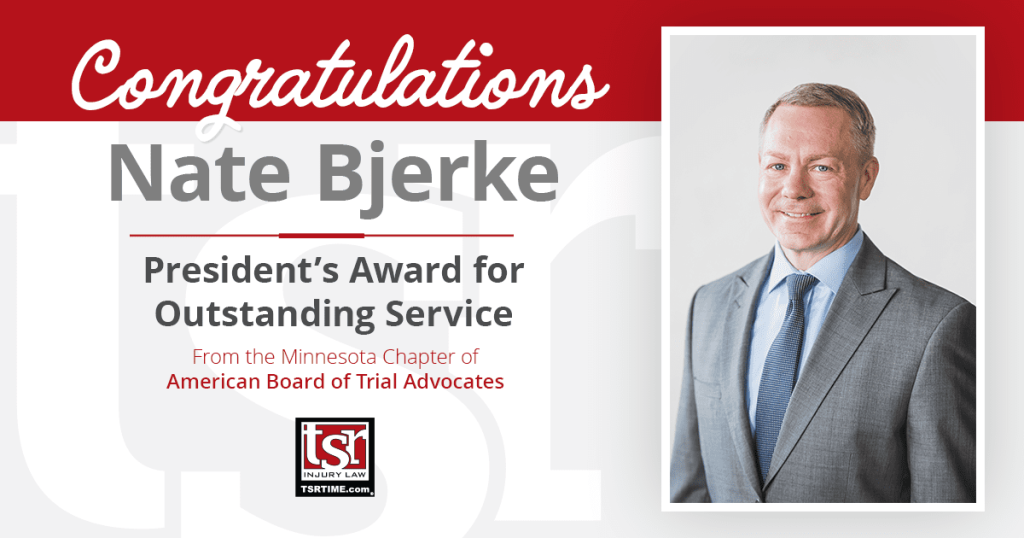
Nate Bjerke Receives President’s Award for Outstanding Service from Minnesota Chapter of ABOTA

We are proud to announce firm partner Nate Bjerke (pictured on the far right) received the President’s Award for Outstanding Service from the Minnesota Chapter of the American Board of Trial Advocates (ABOTA) earlier this month.

Current image: nate bjerke president's award

The award is recognition for judges and lawyers who show a commitment to preserving the right to a jury trial in civil cases, a right granted in the U.S. Constitution.

Bjerke and two others won the award for forming a committee for civics education for school-aged children to educate them on how the government and judicial system work.

We are also proud to announce Bjerke was voted as an officer of the Minnesota Chapter of ABOTA. He is going to serve as Secretary in 2023 and currently serves on the Executive Committee. Bjerke should advance to President of the Minnesota Chapter of ABOTA by 2026.

ABOTA has strict guidelines for admission, including trying a minimum of 10 cases as lead counsel and receiving recommendations from judges and lawyers an attorney has faced at trial.

The general purpose of ABOTA is to promote improvement in the ethical and technical standards of practice so individual litigants receive effective legal representation.

How Refusing Medical Treatment Might Affect Your Injury Claim

Current image: chiropractic adjustment of patient's back

There are many decisions injury victims make that they do not realize could hurt their claims for compensation. One such decision is refusing medical care, either at the scene or later during the treatment process.

Refusing treatment hurts you on many levels. It will hurt your chances of actually recovering from the crash because usually simply waiting does not fix injuries. Ignoring treatment parameters also will hinder you from recovering full compensation for your damages. The insurance company will claim if you do not need to treat then your injuries are not that bad. They could also say you are not taking appropriate steps to mitigate your damages.

Below, we detail the problems with refusing medical treatment when seeking compensation after a car crash. It is important to note there are legitimate reasons to refuse medical treatment, and you may still be able to seek compensation if you did not get treatment at the scene.

TSR Injury Law is ready to assist you with the legal process. Call (612) TSR-TIME.

Why Crash Victims May Refuse Treatment at the Scene

Sometimes crash victims refuse medical treatment at the scene. They may think they have not suffered significant injuries. They may also think whatever harm they suffered will heal on its own without treatment or they are worried about how to pay for an ambulance or emergency room visit.

Crash victims may think there is no way they could have suffered serious injuries in the crash. They may think the crash was not that big of a deal because they were able to get out of the car and their vehicle did not sustain catastrophic damage.

However, it is important to understand a crash can release adrenaline, and this could mask your symptoms or at least make it feel like they are not that bad. Your symptoms may worsen in the hours and days after the crash.

Waiting to seek treatment is dangerous for your health because your injuries could get much worse. It may also contribute to you having long-term medical problems or at least a much longer recovery period.

Although you are seeking compensation, your top priority should be your health, particularly your ongoing health.

The Problem With Refusing Treatment at the Scene

If you refuse treatment at the scene, the insurance company is surely going to try and use it against you. They will claim you did not get hurt in the crash – if you did get hurt, why would you refuse treatment?

It is important to understand that you can still file a claim if you refused treatment at the scene. The insurance company will argue about causation of later treatment to the crash. The sooner you seek care after the crash the less likely this argument will work. If you are in pain you can still go to Urgent Care, the Emergency Room or your family doctor. The main goal is to get better and not allow the injuries to get worse, but the secondary effect is to also better document the injury to the crash.

Refusing Specific Types of Medical Care Later in the Process

While getting medical care after a crash is important, so is following through with your medical care. If you miss appointments or refuse treatment it could hurt the value of your claim.

The insurance company will argue you have fully recovered, otherwise why would you be stopping treatment or refusing something recommended by your doctor. The insurance company could even claim you are just trying to make your injuries worse to drive up the cost of your claim.

You have the right to make your own decisions about medical care. For example, some believe in chiropractic care even if insurance companies do not. Some believe in pain management care of medication or injections, where insurance companies believe a massage and stretching are enough.

You may also question if a doctor is recommending the appropriate treatment. You could get a second opinion and undergo alternative treatment. If the alternative treatment is something recognized by the medical community as appropriate for your injury, it will be harder for the insurance company to exclude the cost of this treatment from your claim.

If you and your family have doubts about a doctor’s recommendations, it is important to discuss the situation with them. You should not make decisions about getting surgery to try to inflate the value of your claim or because you think refusing treatment could hurt your claim.

As far as your claim is concerned, your Bloomington-based auto accident attorney can discuss how aspects of your treatment might impact the value of your claim. Unlike the insurance company, we are working to protect the full value of a claim for compensation.

Steps You Can Take to Protect Your Claim

If you refused treatment at the scene, you should still get to the hospital right away. Talk to an experienced attorney about the fact you refused treatment at the scene.

If you miss an appointment, you can reschedule it to help prevent a missed appointment from hurting your claim.

If do not want to get a certain type of treatment, discuss it with your attorney to learn how your claim may be affected. Decisions about medical treatment are up to you and your family, but it is also important to know how your claim may be impacted.

Set Up a Free Consultation at TSR Injury Law

If you suffered an injury in a car crash, you could greatly benefit from the assistance of a licensed attorney. Insurance companies routinely make lowball settlement offers and find reasons to deny or underpay claims.

Our firm is ready to help you pursue the compensation you need with no upfront costs. We have been helping motor vehicle crash victims for decades and we have obtained hundreds of millions on behalf of our clients.

TSR Injury Law. Licensed. Local. Lawyers. Call (612) TSR-TIME.